


The Non-Quartz Glass Products Manufacturer!
Alfa Quartz was established in 2013. It is a manufacturer that researches, develops, produces, and sells high-quality semiconductor quartz components, quartz glass instruments, optical quartz glass sheets, PV (Photovoltaic) quartz boats/boat trays, and other accessories.

Why choose us
Professional Team
We provide leading providers of analysis, testing, quality assessment, and failure analysis solutions. As a recognized expert in the field of glass, we provide our customers with reliable solutions, explanations and recommendations.
Best Quality Control
In order to present the best performance, we conduct high standard tests each product between every step. It is guaranteed that our products are qualified by ISO 9001, RoHs, HF and REACH certifications.
Main Market
Our quartz products are sold well in many countries such as the United States, Germany, the United Kingdom, Canada, Japan, and South Korea.
Advantages of Glass
Transparency and Light Transmission
Transparency is one of the major strengths of glass because of its efficiency in passing natural light. This quality adds the beauty of structures and rooms by giving them a light and vast look as compared to small and congested looks. The large undertaking of glass work in structures whether in the form of windows or transparent walls enables sufficient sunlight to get into the building thus cutting down on expenses incurred on artificial lighting systems In addition the large glass calls for a chance to view the outside environment and to be seen as a part of it. This can have a positive impact on the feeling and efficiency of the users of the house or firm in the residential and commercial areas respectively.
Energy Efficiency
Advanced forms of glass technology like the low-emissivity (low-E) glass are quite useful in energy conservation. Low-E glass primarily has a thin film of metals that reflects the heat in the form of infrared light allowing heat to remain inside during winter and outside during summer. This goes a long way to ensure that the indoor climate is regulated all through without so much dependence on the HVAC systems. For this reason, energy efficient glasses help reduce energy costs with an effect of decreasing the proportion of greenhouse gases emissions thus playing an important role in green buildings.
Safety and Security
Some varieties of glass that are available in the markets today include; the tempered, laminated types with features of safety and security. Toughened glass is processed through heat in a way that makes it even stronger than the normal glass, and in the event that it breaks, the outcome is a bunch of small, dull edges that positively cannot harm anyone. Laminated glass, which is made of two or more pieces of glass having a layer, does not crumble into pieces when broken, thus offering a physical barrier against burglary and flying projectiles. These properties make safety glass suitable to be used in vehicles, stores, and any buildings that are vulnerable to break-ins.
Sound Insulation
Two of the most common glasses, laminated and the double-glazed ones, offer effective sound proofing to structures. Basically, laminated glass having PVB interlayer and double-glazed units with air or any kind of gaseous gap between two glasses can help in reducing noise problem substantially. This means that glass is suitable to be used for constructions within areas of sound pollution like adjacent to highways or in densely populated areas. Better Acoustic comfort has a positive impact on social well-being and occupational performance due to the reduced noise level indoors.
Glass Material Applications
Semiconductor Industry. Glass is vital to the production of semiconductor wafers. Glass wafers act as a carrier substrate, facilitating the safe handling of thinner and more delicate silicone materials.
Consumer Appliances. Oven doors and stove tops are typically comprised of glass material.
Biotechnology. The biotech sector relies on borosilicate glass wafers for a variety of medical devices because of its clear optical transparency and resistance to high temperatures, radiation, and energy. Glass wafers also act as a carrier substrate to protect silicone devices used in nanotechnology.
MEMs and Electronics. TV, computer, and smartphone screens are all made from glass. Engineers use special glass types for touchscreen displays. Glass wafers are also used as substrate carriers and wafer packaging for sensitive components in microelectronic mechanical systems (MEMs) and electronics.
Automotive and transportation. Windshields, headlights, and backlights make use of specific glass materials. Glass is also used as a source material for many lightweight, reinforced structural components found in automobiles, airliners, helicopters, ocean cruisers, and other vehicles.
Medical technology. As an example of the use of glass in the medical field, X-ray machines contain glass.
Renewable energy. Low-iron or extra-clear glass has extremely limited light reflection properties, which makes it an excellent fit for solar cell covers. Maximum amounts of sunlight can come through the glass cover and help charge the solar battery.
Integrated Circuit (IC) Packaging. Glass vias (TGV) and wafer-level glass capping (WLC) are used to ICs against corrosion or impacts to ensure optimal functionality. They serve a dual purpose of holding contacts to external circuits in place.
Glass Production and Processing

-
Raw Material Preparation
A mixture of silica sand, soda, and limestone is prepared.
-
Melting
The mixture is melted at temperatures above 1500 °C.
-
Shaping
The molten glass is shaped in heat-resistant molds.
-
Cooling and Hardening
The glass is slowly cooled and hardened.
Most Common Uses for Glass
Packaging
From jars for food, bottles for drinks, and storage containers, glass is one of the most common packaging items.
Dinnerware
Glass is often used to make bowls, platters, glasses, lids, and plates. Glass dinnerware is non-porous, meaning it does not absorb food particles and prevents the growth of bacteria, making your dishware food-safe and hygienic.
Buildings and Housing
Windows, shower surrounds, and doors are all familiar places where glass is used to construct buildings and housing.
Interior Design and Furniture
Glass is one of the most commonly used interior design materials. You’ll find it in tables, mirrors, shelves, lighting, and even in frames hanging on the wall.
Appliances and Electronics
Consider all the uses for glass in the making of appliances and electronics. Oven doors, cooktops, computer screens, smartphones, and TVs are all household items manufactured using glass.
Automotive and Transport
Windshields, vehicle windows, structural components, and lighting are all areas where glass is used in the automotive and transport industry.
Medical Technology
In the medical technology field, glass is a common element in many products. You’ll find it used in optical glass, life science engineering, and biotechnology.
Radiation Protection
Glass is naturally effective at protecting from x-rays and gamma-rays, making it invaluable where line-of-sight is required, such as in medical radiography.
Fiber Optic Cables
Fiber optic cables that carry network connections for both internet and cable are manufactured using multiple strands of skinny glass fiber bundled together with a flexible sheath.
Renewable Energy
Glass is a critical element of renewable energy sources. Solar-energy panels and wind turbines are both manufactured using glass.
Our factory
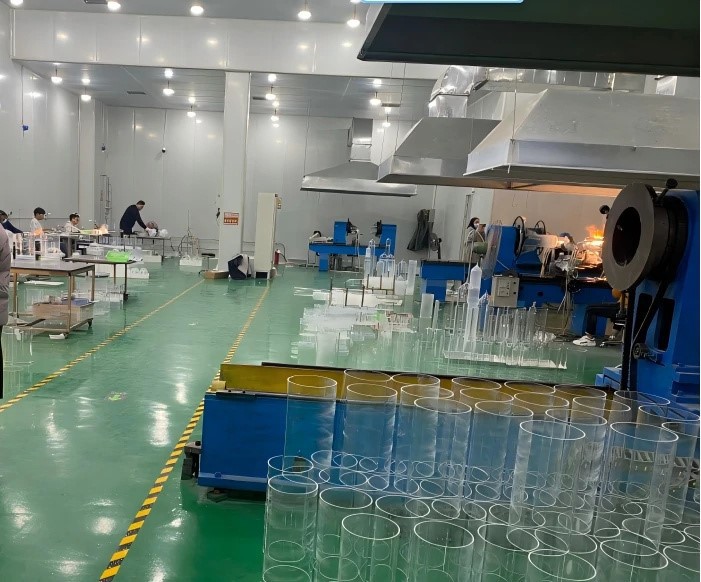
The company covers an area of 7,500 square meters with a building area of 9,000 square meters. It has more than 100 employees. The production machines for the cold and hot processing of quartz glass are precise and complete. The processes are mature and stable. The processing technology and product quality have reached a medium to high level in the industry.



FAQ
As one of the leading non-quartz glass products manufacturers and suppliers in China, we warmly welcome you to wholesale bulk non-quartz glass products for sale here from our factory. Also, customized service is available.
Glass Process, non quartz glass products