


The Blank Material Manufacturer!
Alfa Quartz was established in 2013. It is a manufacturer that researches, develops, produces, and sells high-quality semiconductor quartz components, quartz glass instruments, optical quartz glass sheets, PV (Photovoltaic) quartz boats/boat trays, and other accessories.



Why choose us
Professional Team
We provide leading providers of analysis, testing, quality assessment, and failure analysis solutions. As a recognized expert in the field of glass, we provide our customers with reliable solutions, explanations and recommendations.
Best Quality Control
In order to present the best performance, we conduct high standard tests each product between every step. It is guaranteed that our products are qualified by ISO 9001, RoHs, HF and REACH certifications.
Main Market
Our quartz products are sold well in many countries such as the United States, Germany, the United Kingdom, Canada, Japan, and South Korea.
Our company provides the following products
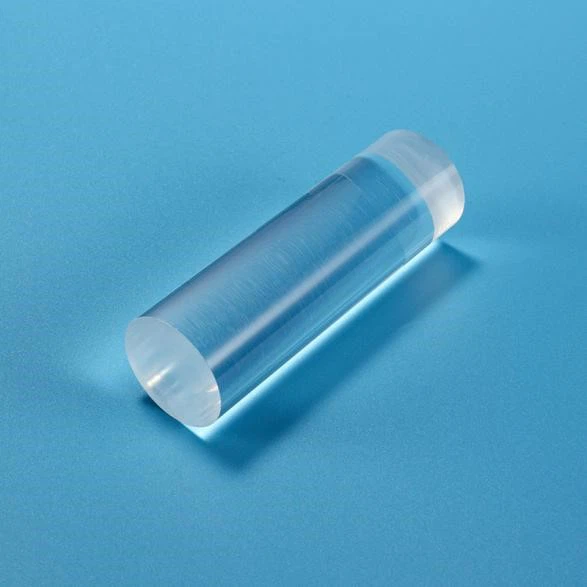
Quartz Rod
Material: 99.99% fused quartz glass (SiO₂)
Technique: Cutting, polishing, drilling, etching, etc.
Size: Custom
MOQ: 1 pcs
|
Physical Properties |
Values |
|
Purity |
>99.99% |
|
Density |
2.2g/cm3 |
|
Transparency |
>90% |
|
Mohs Hardness |
5.5--6.5 |
|
Deformation Point |
1280℃ |
|
Softening Point |
1750℃ |
|
Annealing Point |
1250℃ |
|
Specific Heat (20 - 350°C) |
670J/kg.℃ |
|
Thermal Conductivity (20°C) |
1.4W/m.℃ |
|
Heat Conductivity (w/m.k,1000 ℃ ) |
1.0-1.2 |
|
Refractive Index |
1.4585 |
|
Coefficient of Thermal Expansion |
5.510 -7cm/cm.℃ |
|
Hot - working Temperature |
1750~2050℃ |
|
Short - term Service Temperature |
1450℃ |
|
Long - term Service Temperature |
1100℃ |
Advantages of Quartz Rod
High temperature resistance: The softening point temperature of the quartz glass rod is about 1730 ℃, which can be used for a long time at 1100 ℃, and the use temperature can reach 1450 ℃ in a short time.
Good edge performance: The resistance of quartz glass rod is 10000 times that of ordinary PE pipe, which is an excellent electrical insulating material and has good insulation performance even at high temperature.
Good thermal stability: The thermal expansion coefficient of quartz glass rod is very small, and it can withstand severe temperature changes. The quartz glass rod will not crack when heated to about 1100 ℃ and put into normal temperature water.
Good light transmittance: Quartz glass rod has good light transmittance in the whole spectrum band from ultraviolet to infrared, and the visible light transmittance is more than 93%, especially in the ultraviolet spectrum region, the Z large transmittance can reach more than 80.
Strong corrosion resistance: Except hydrofluoric acid, quartz glass rod hardly reacts with other acid substances. Its acid resistance is 30 times that of ceramic and 150 times that of stainless steel. Especially, its chemical stability at high temperature is incomparable with any other engineering material.
Applications of Quartz Rods
Quartz Rods in Scientific Research and Laboratories
In scientific research and laboratories, quartz rods are essential for precision equipment and experiments. Their high chemical purity and thermal stability make them ideal for use in spectrometers, chromatographs, and other analytical instruments. Quartz rods are also used in the construction of lab equipment such as stirrers, sample holders, and optical components, where precision and resistance to contamination are critical. Their ability to withstand harsh chemicals and extreme temperatures ensures reliable performance in sensitive experimental setups.
Quartz Rods in Semiconductor and Electronics Industries
The semiconductor and electronics industries rely on quartz rods for manufacturing and circuitry components. These rods are used in the production of silicon wafers, where their high thermal resistance and low thermal expansion are crucial for maintaining dimensional stability during high-temperature processes. Quartz rods are also employed in the fabrication of optical fibers, sensors, and other electronic components, where their electrical insulation properties and transparency to UV and infrared light are highly valued. Their durability and precision make them indispensable in cleanroom environments, where even the slightest impurity can compromise product quality.
Quartz Rods in Aerospace and Aviation
In aerospace and aviation, quartz rods are used in high-temperature and high-stress environments due to their durability and thermal resistance. They are commonly found in the construction of aircraft windows, sensors, and communication systems, where their ability to withstand extreme conditions is essential. Quartz rods are also used in satellite components and space exploration equipment, where their resistance to radiation and thermal shock ensures reliable performance in the harsh conditions of outer space. Their lightweight nature and strength make them an ideal material for reducing weight without compromising structural integrity.
Quartz Rods in Lighting and HVAC Industries
The lighting and HVAC industries utilize quartz rods as heating elements in heaters and fixtures, thanks to their ability to withstand prolonged exposure to high temperatures. In halogen lamps and UV lighting systems, quartz rods serve as the envelope material, providing excellent thermal stability and UV transparency. In HVAC systems, quartz rods are used in infrared heaters and industrial furnaces, where their high thermal efficiency and durability ensure consistent performance. Their resistance to thermal shock and chemical corrosion makes them a reliable choice for applications requiring long-term exposure to heat and harsh environments.
Quartz Sand
Quartz sand is a natural mineral material primarily composed of silicon dioxide (SiO₂), produced by crushing, screening, and processing quartz rock. Due to its high hardness, chemical stability, and heat resistance, it is widely used in various industrial fields.
|
Physical Properties |
Values |
|
Purity |
>99.99% |
|
Density |
2.2g/cm3 |
|
Transparency |
>90% |
|
Mohs Hardness |
5.5--6.5 |
|
Deformation Point |
1280℃ |
|
Softening Point |
1750℃ |
|
Annealing Point |
1250℃ |
|
Specific Heat (20 - 350°C) |
670J/kg.℃ |
|
Thermal Conductivity (20°C) |
1.4W/m.℃ |
|
Heat Conductivity (w/m.k,1000 ℃ ) |
1.0-1.2 |
|
Refractive Index |
1.4585 |
|
Coefficient of Thermal Expansion |
5.510 -7cm/cm.℃ |
|
Hot - working Temperature |
1750~2050℃ |
|
Short - term Service Temperature |
1450℃ |
|
Long - term Service Temperature |
1100℃ |
High Hardness: Mohs hardness of 7, with strong wear resistance.
Chemical Inertness: Resistant to acids (except hydrofluoric acid) and corrosion, minimally reactive with most chemicals.
Heat Resistance: Melting point around 1750~2050℃°C, suitable for high-temperature environments.
Insulation: Excellent electrical insulation properties.
Color & Form: Typically white or colorless transparent granules; may appear yellow, red, etc., when impurities are present.

Application of Quartz Sand
In the field of building materials: Quartz sand is an important raw material for manufacturing building materials such as concrete, bricks, gypsum boards, etc. Quartz sand can be used as a filler for building materials, improving their strength and hardness, while also increasing their fire resistance.
Glass industry: Quartz sand is an important raw material for glass manufacturing. The main component of glass is silica, and quartz sand is the most commonly used source of silica. Quartz sand can be made into high-purity glass with high transparency and chemical stability.
Electronic industry: Quartz sand is an important raw material for manufacturing electronic components. Quartz sand can be made into electronic components such as quartz crystal resonators, quartz crystal filters, and quartz crystal oscillators, which are widely used in electronic devices.
Chemical industry: Quartz sand can be used to manufacture chemical raw materials, such as silicic acid, silicate, silicone oil, etc. Silicate is the main component of many building materials, and silicone oil is an important raw material for manufacturing high-temperature lubricants and preservatives.
Coatings, paints, and ink industries: Quartz sand can be used as a filler for coatings, paints, and inks, improving the hardness and wear resistance of products. Quartz sand can also serve as a thickener for coatings and paints, making the product easier to apply and use.
Ceramic industry: Quartz sand can be used as a raw material for ceramics to make ceramic products with high hardness and wear resistance. Quartz sand can also be used as a filler and thickener for ceramics, improving the quality and performance of products.
Water treatment: Quartz sand can be used as a filtering medium for water treatment, filtering impurities and harmful substances in the effluent. Quartz sand can also be used to manufacture filter materials and filters for water treatment equipment.
Our factory
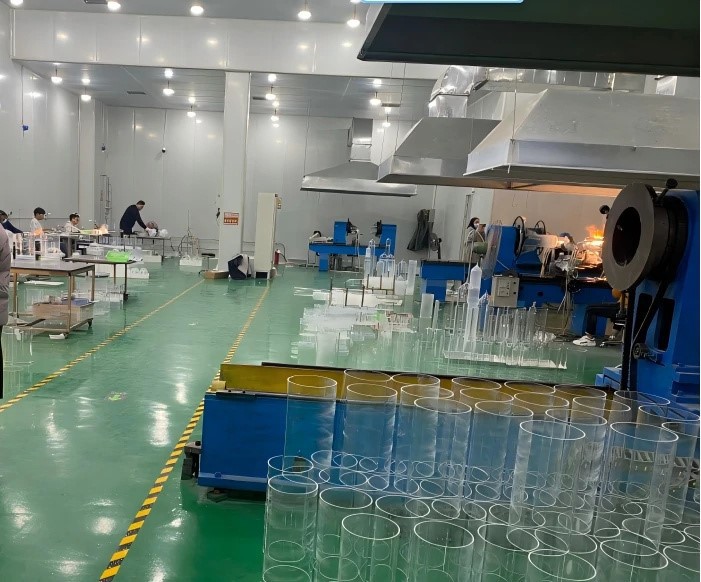
The company covers an area of 7,500 square meters with a building area of 9,000 square meters. It has more than 100 employees. The production machines for the cold and hot processing of quartz glass are precise and complete. The processes are mature and stable. The processing technology and product quality have reached a medium to high level in the industry.



FAQ
As one of the leading blank material manufacturers and suppliers in China, we warmly welcome you to wholesale bulk blank material for sale here from our factory. Also, customized service is available.
Quartz Ingot, Quartz Rod, Raw Material Of Quartz Plate