


The Laboratory Glassware Manufacturer!
Alfa Quartz was established in 2013. It is a manufacturer that researches, develops, produces, and sells high-quality semiconductor quartz components, quartz glass instruments, optical quartz glass sheets, PV (Photovoltaic) quartz boats/boat trays, and other accessories.


Why choose us
Professional Team
We provide leading providers of analysis, testing, quality assessment, and failure analysis solutions. As a recognized expert in the field of glass, we provide our customers with reliable solutions, explanations and recommendations.
Best Quality Control
In order to present the best performance, we conduct high standard tests each product between every step. It is guaranteed that our products are qualified by ISO 9001, RoHs, HF and REACH certifications.
Main Market
Our quartz products are sold well in many countries such as the United States, Germany, the United Kingdom, Canada, Japan, and South Korea.
|
Physical Properties |
Values |
|
Purity |
>99.99% |
|
Density |
2.2g/cm3 |
|
Transparency |
>90% |
|
Mohs Hardness |
5.5--6.5 |
|
Deformation Point |
1280℃ |
|
Softening Point |
1780℃ |
|
Annealing Point |
1250℃ |
|
Specific Heat (20 - 350°C) |
670J/kg.℃ |
|
Thermal Conductivity (20°C) |
1.4W/m.℃ |
|
Heat Conductivity (w/m.k,1000 ℃ ) |
1.0-1.2 |
|
Refractive Index |
1.4585 |
|
Coefficient of Thermal Expansion |
5.5*10 -7cm/cm.℃ |
|
Hot - working Temperature |
1750~2050℃ |
|
Short - term Service Temperature |
1300℃ |
|
Long - term Service Temperature |
1100℃ |
Advantages of Laboratory Glassware
Chemical Resistance
Inert to most acids, bases, and solvents.
Thermal Stability
Withstands high heat and sudden temperature changes.
Transparency
Allows visual monitoring of reactions.
Precision
Calibrated glassware ensures accurate measurements.
Types of Laboratory Glassware

Beakers – One of the most common types of laboratory glassware, beakers are basic containers used to hold samples and reagents.
Burettes – Used to dispense liquid in exact quantities.
Pipettes (Bulb and Graduated) – Used to move a small, measured amount of fluid.
Condensers – There are many varieties of condensers, but they are all typically designed to cool or heat liquids.
Desiccators – Absorb moisture from a substance.
Drying pistols – They perform the same task as desiccators, but the pistol is a more direct way of removing moisture.
Funnels – Designed with a tapered neck to enable liquid to be poured accurately into a container with a narrow opening.
Glass Sampling Tubes – Sampling tubes are used to take small measurements of a liquid.
Graduated Cylinders – Very similar to a beaker but with volume measurements.
Petri dishes – Another well-known item from people’s school days. They are very shallow, round dishes used to culture cells.
Slides – To view items under a microscope, items are placed between two glass slides.
Vacuum Manifolds – Also known as Schlenk Lines, they are a commonly used apparatus in chemistry. They are especially useful for manipulating air-sensitive compounds.
Vials – Small bottles that are used for storage.

Best Practices for Laboratory Glassware Safety
Inspection Before Use
Examine glassware for cracks, chips, or defects before every use. A thorough inspection helps identify weaknesses that could lead to failure during use, avoiding accidents or contamination.
Discard damaged items to prevent accidental breakage. Use a clear disposal protocol to ensure broken or compromised glassware is removed safely and promptly from the work area.
Proper Handling
Use both hands to carry large or heavy items. This reduces strain and the likelihood of dropping the glassware, especially when moving delicate or expensive equipment.
Support the base of flasks and beakers rather than holding them by the neck. Holding at stress points can lead to cracking, particularly when the glassware contains liquids.
Temperature Management
Gradually heat glassware to prevent thermal shock. Sudden changes in temperature can cause glass to expand unevenly and shatter. Use a controlled heating source and increase temperature incrementally.
Avoid placing hot glassware on cold surfaces or vice versa. Use insulating pads or trivets to maintain a stable temperature transition.
Use heat-resistant gloves when handling heated glassware. Ensure gloves are appropriately rated for high temperatures and check for wear before use.
Appropriate Glassware Cleaning
Rinse glassware immediately after use to prevent residue buildup. Prompt cleaning prevents hard-to-remove deposits and potential chemical reactions.
Use non-abrasive cleaning tools to avoid scratches. Scratched glass weakens structural integrity and may harbor contaminants.
Dry thoroughly before storing to prevent chemical reactions or contamination. Residual moisture can alter the composition of stored chemicals or promote microbial growth.
Storage Tips
Store glassware in designated cabinets or racks to prevent tipping or accidental knocks. Opt for padded or segmented racks to minimize movement during storage.
Avoid stacking fragile items unless they are specifically designed to nest. When stacking, use protective layers, such as foam sheets, to prevent contact damage.
Safe Disposal of Broken Glass
Use a designated glass disposal container for broken or discarded glassware. These containers should be sturdy, puncture-resistant, and clearly labeled for laboratory use.
Label the container clearly to avoid accidental injuries during waste handling. Include instructions for proper disposal to ensure compliance with safety protocols.
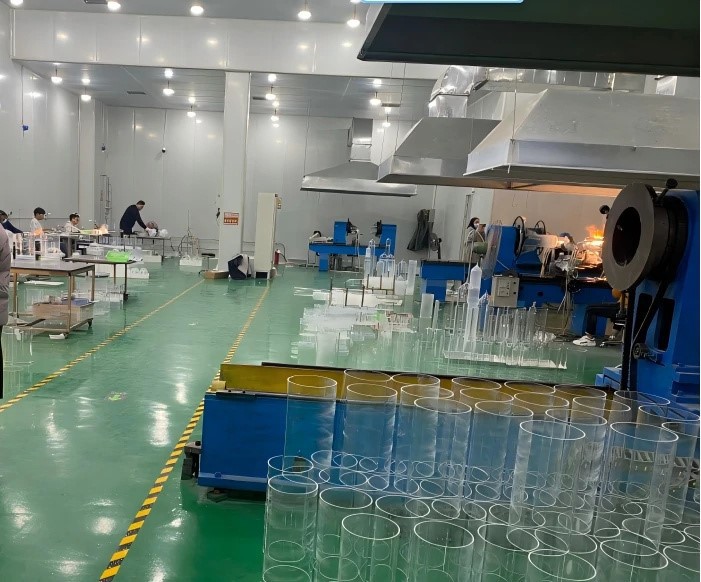
Our factory
The company covers an area of 7,500 square meters with a building area of 9,000 square meters. It has more than 100 employees. The production machines for the cold and hot processing of quartz glass are precise and complete. The processes are mature and stable. The processing technology and product quality have reached a medium to high level in the industry.



FAQ
As one of the leading laboratory glassware manufacturers and suppliers in China, we warmly welcome you to wholesale bulk laboratory glassware for sale here from our factory. Also, customized service is available.
Graduated Measuring Cylinder, Quartz Evaporating Dish, Quartz Flask