

How much liquid can a conical flask hold?
Leave a message

Hey there! As a supplier of conical flasks, I often get asked, "How much liquid can a conical flask hold?" Well, let's dive right into this question and explore the ins and outs of conical flask capacities.
First off, conical flasks come in a variety of sizes. You've got the small ones, which are great for doing small - scale experiments or when you just need a tiny amount of liquid for a test. Then there are the medium - sized ones that are super versatile and can be used in all sorts of lab setups. And of course, the large conical flasks, which are perfect for when you need to mix or store a relatively large volume of liquid.
The capacity of a conical flask is usually marked on the side of the flask itself. It's typically measured in milliliters (ml). You might find conical flasks with capacities like 50 ml, 100 ml, 250 ml, 500 ml, and even 1000 ml or more.
Let's talk about how these capacities are determined. The shape of a conical flask is, as the name suggests, conical. It has a narrow neck at the top and a wider base at the bottom. This shape is not just for looks; it actually serves a practical purpose. The narrow neck helps to prevent spills and also makes it easier to add or remove liquids using pipettes or other lab tools.
To calculate the volume of a conical flask, we can use the formula for the volume of a cone, which is (V=\frac{1}{3}\pi r^{2}h), where (V) is the volume, (r) is the radius of the base of the cone, and (h) is the height of the cone. However, in real - world lab situations, manufacturers usually measure the volume through calibration. They fill the flask with a known volume of liquid and mark the corresponding level on the flask.
Now, why does the capacity matter? Well, if you're a scientist or a researcher, you need to know exactly how much liquid you can put in a flask for your experiments. For example, if you're doing a chemical reaction that requires a specific volume of reactants, using a conical flask with the wrong capacity could lead to inaccurate results.
If you're working on a small - scale experiment, a 50 ml or 100 ml conical flask might be just right. You can precisely measure and mix your reagents in these smaller flasks. On the other hand, if you're doing a large - scale synthesis or need to prepare a large volume of a solution, a 500 ml or 1000 ml conical flask would be more appropriate.

It's also important to note that when using a conical flask, you shouldn't fill it to the brim. You need to leave some headspace to prevent spills when you're swirling the flask to mix the contents. A good rule of thumb is to fill the flask to about 70 - 80% of its maximum capacity.
In addition to conical flasks, we also offer other types of laboratory glassware. For instance, if you're looking for something different, you might be interested in Quartz Test Tube. These test tubes are made of high - quality quartz and are great for various heating and chemical testing applications.
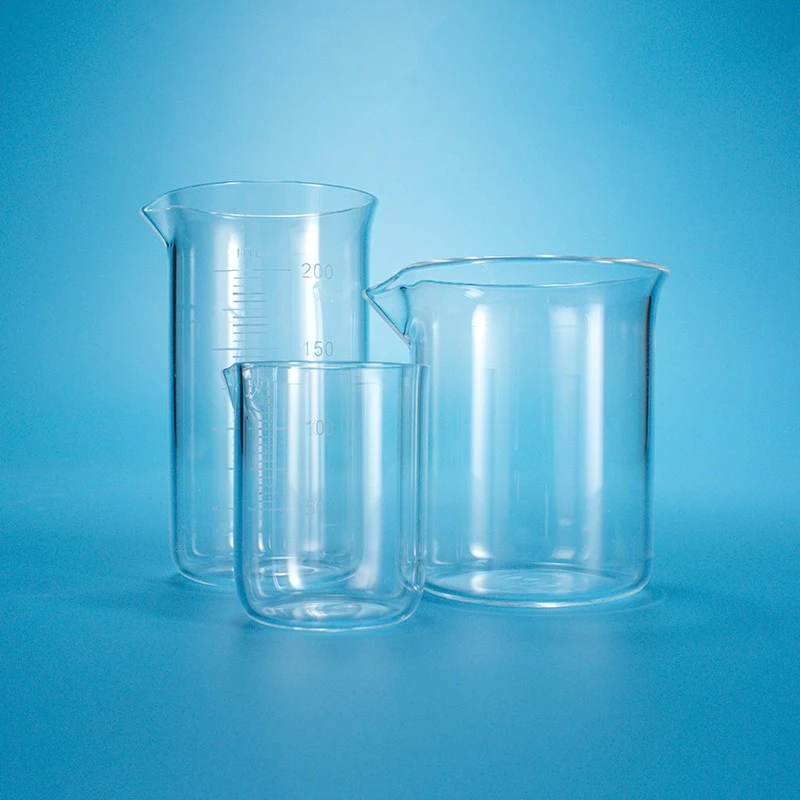
Another option is the Quartz Beaker. Quartz beakers are known for their excellent heat resistance and chemical stability. They're often used for mixing, heating, and storing liquids in the lab.
And if you're into distillation processes, our Quartz Distilling Flask is a great choice. It's designed specifically for distillation, with a shape that helps to separate different components of a liquid mixture.
When it comes to choosing the right glassware for your lab, it's all about understanding your needs. Consider the type of experiments you'll be doing, the volume of liquids you'll be working with, and the conditions under which you'll be using the glassware.
We take pride in providing high - quality conical flasks and other laboratory glassware. Our products are made from top - notch materials and are carefully crafted to meet the strictest quality standards. Whether you're a university lab, a research institution, or an industrial laboratory, we've got the glassware you need.
If you're interested in purchasing conical flasks or any of our other laboratory glassware, we'd love to hear from you. We can offer you competitive prices, fast shipping, and excellent customer service. Just reach out to us, and we'll be happy to discuss your requirements and help you find the perfect glassware for your lab.
In conclusion, knowing how much liquid a conical flask can hold is crucial for any lab work. By understanding the different capacities available and how they're determined, you can make more informed decisions when choosing the right flask for your experiments. And remember, we're here to support you with all your laboratory glassware needs.
References
- General knowledge of laboratory glassware and their applications in scientific research.
- Basic principles of geometry for calculating the volume of conical shapes.


