

How to measure the volume of a Quartz Crucible?
Leave a message

Hey there! As a supplier of quartz crucibles, I often get asked about how to measure the volume of these nifty little lab tools. It's actually way more interesting than you might think, and in this blog post, I'm gonna walk you through a few different methods. Whether you're a newbie scientist or a seasoned pro, understanding how to accurately measure the volume of a quartz crucible is super important for carrying out experiments right.
Method 1: Using Water Displacement
One of the easiest and most common ways to measure the volume of a quartz crucible is through water displacement. This method is based on Archimedes' principle, which basically says that the volume of an object is equal to the volume of water it displaces.
Here's what you'll need:
- A large beaker or container that can hold the crucible and enough water to submerge it
- A graduated cylinder
- Distilled water
- A pair of tongs to handle the crucible
First, fill the large container with enough distilled water so that the crucible can be fully submerged. Then, use the tongs to carefully place the dry crucible into the water. Make sure no air bubbles are trapped inside the crucible. As the crucible goes into the water, it'll displace a certain volume of water.
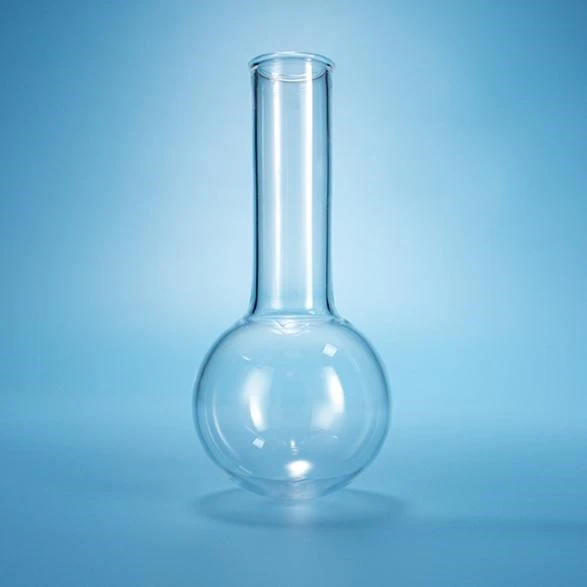

Next, use the graduated cylinder to measure the volume of the displaced water. Simply pour the water that has overflowed into the graduated cylinder and read the measurement at the bottom of the meniscus. The volume you measure is the volume of the quartz crucible.
This method is simple, but it requires some precision. Make sure to clean the crucible before and after the measurement to avoid any contamination. Also, reading the graduated cylinder accurately is crucial. If you're into this kind of water - based lab work, you might also be interested in Quartz Watch Glasses, which are handy for holding small amounts of liquids or solids during experiments.
Method 2: Mathematical Calculation
If your quartz crucible has a regular shape, like a cylinder or a cone, you can calculate its volume using mathematical formulas.
Cylindrical Crucibles
For a cylindrical crucible, the formula for volume is V = πr²h, where V is the volume, r is the radius of the base of the cylinder, and h is the height of the cylinder.
To measure the radius, you can use a caliper. Place the caliper across the widest part of the base of the crucible and divide the measurement by 2 to get the radius. Measure the height from the bottom of the crucible to the top edge. Once you have the values of r and h, you can plug them into the formula and calculate the volume.
Conical Crucibles
If your crucible is conical, the formula for volume is V = (1/3)πr²h, where r is the radius of the base of the cone and h is the height. Similar to the cylindrical crucible, use a caliper to measure the radius of the base and a ruler to measure the height. Then, just do the math!
This method is great when you have a well - defined shape. But keep in mind that real - world crucibles might have some irregularities, so the calculated volume might be a bit off. If you're doing more complex chemical analyses, you might also want to check out Kjeldahl Flasks, which are used for nitrogen determination in organic substances.
Method 3: Using a Liquid with Known Density
Another way to measure the volume of a quartz crucible is by using a liquid with a known density. You'll need a liquid like ethanol, which has a density of about 0.789 g/cm³ at 20°C.
Here's how it works:
- Weigh the empty crucible using a precise balance and record its mass (m1).
- Fill the crucible with the liquid of known density. Make sure the liquid fills the crucible completely without any air bubbles.
- Weigh the crucible again with the liquid inside and record the mass (m2).
- Calculate the mass of the liquid (m = m2 - m1).
- Use the formula V = m/ρ, where V is the volume, m is the mass of the liquid, and ρ is the density of the liquid.
This method can be quite accurate, but it requires a good balance to measure the masses precisely. After the measurement, you'll need to clean the crucible thoroughly to remove any traces of the liquid. If you're looking for high - quality containers to store small samples, Quartz Threaded Vial might be a good option for you.
Why Accurate Volume Measurement Matters
You might be wondering why it's so important to measure the volume of a quartz crucible accurately. Well, in scientific experiments, even the smallest error can lead to incorrect results. For example, if you're working on a chemical reaction that requires a specific amount of reactants in a crucible, an inaccurate volume measurement can mess up the reaction ratio.
This can be a big deal in research labs where reproducibility of results is key. It can also affect the quality control in industrial applications where quartz crucibles are used for melting and casting materials. So, getting that volume right is crucial for any successful experiment or production process.
In Need of High - Quality Quartz Crucibles?
If you're in the market for top - notch quartz crucibles, you've come to the right place. As a supplier, I take pride in offering high - quality products that meet the strict standards of scientific research and industrial use. Our quartz crucibles are made from the purest quartz materials and are designed to withstand high temperatures and harsh chemical environments.
Whether you're a university lab, a private research institution, or an industrial company, we have the right quartz crucibles for you. If you have any questions about our products or need more information on measuring their volume, feel free to reach out. Let's start a conversation and see how we can meet your needs!
References
- Young, Hugh D., and Roger A. Freedman. University Physics with Modern Physics. Pearson, 2019.
- Skoog, Douglas A., et al. Fundamentals of Analytical Chemistry. Cengage Learning, 2013.


