

What is the capacity range of conical flasks?
Leave a message

Hey there! As a conical flask supplier, I often get asked about the capacity range of conical flasks. So, I thought I'd write this blog to shed some light on this topic.
First off, let's talk about what conical flasks are. They're those cool-looking, cone-shaped glass containers you often see in labs. They're super useful for all sorts of things, like mixing chemicals, heating liquids, and storing samples. And one of the great things about them is that they come in a wide range of capacities.
The smallest conical flasks I supply usually have a capacity of around 5 mL. These tiny flasks are perfect for working with small amounts of liquid, like when you're doing microscale experiments or just need to hold a little bit of a precious sample. They're also handy for titration in some cases where you're dealing with very concentrated solutions and only need a small volume.
Moving up the scale, we have 10 mL conical flasks. These are a bit more common in educational labs, especially for students who are just starting to learn basic lab techniques. They're still small enough to handle easily but can hold a bit more liquid than the 5 mL ones.
Then there are the 25 mL conical flasks. These are often used in more advanced educational settings or in some professional labs for tasks like preparing small reagent solutions. They offer a bit more flexibility in terms of the volume of liquid you can work with compared to the smaller flasks.
Next on the list are the 50 mL conical flasks. These are quite versatile and are used in a variety of applications. You might use them for simple chemical reactions where you don't need a large volume of reactants, or for storing small amounts of prepared solutions.
Now, we're getting into the medium-sized range. The 100 mL conical flasks are very popular. They're great for a wide range of experiments, from titrations to mixing larger volumes of solutions. Many labs keep a good supply of these on hand because they're so useful in day-to-day work.
Moving up to 250 mL conical flasks, these are often used when you need to work with more substantial volumes of liquid. For example, if you're preparing a buffer solution for a cell culture experiment or conducting a reaction that requires a larger amount of reagents, a 250 mL conical flask would be a good choice.
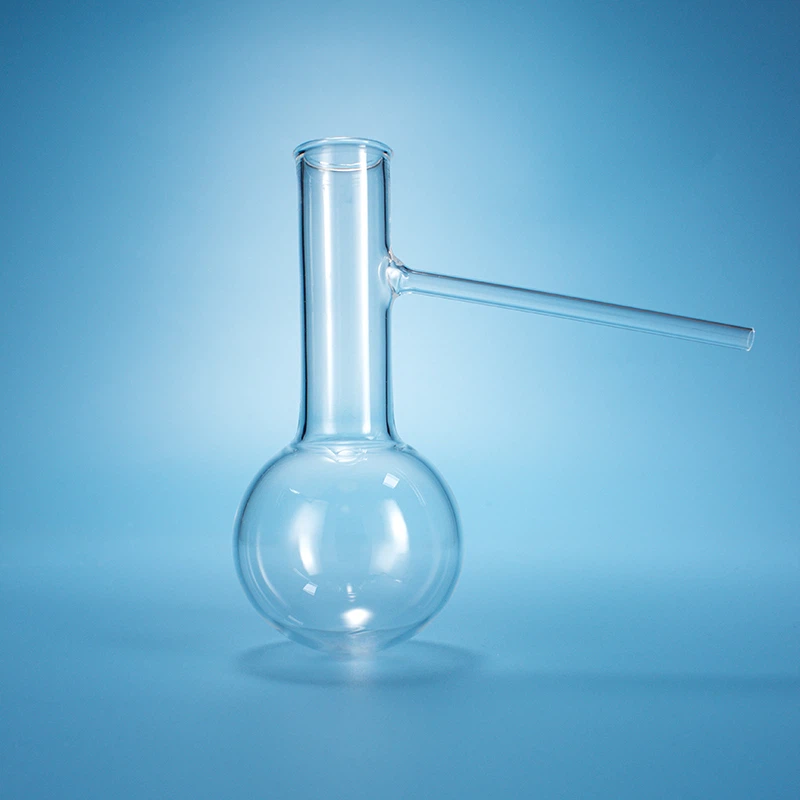

Then there are the 500 mL conical flasks. These are used for even larger-scale experiments or when you need to store a significant amount of liquid. They're commonly found in industrial labs or in research facilities where larger volumes of samples or reagents are required.
Finally, I also supply conical flasks with a capacity of 1000 mL (1 liter). These are the big boys of the conical flask world. They're used for large-scale chemical synthesis, bulk solution preparation, and other applications where you need to handle a large volume of liquid.
So, as you can see, the capacity range of conical flasks can vary from as small as 5 mL to as large as 1000 mL. And the choice of which one to use really depends on the specific needs of your experiment or task.
Now, let's talk about some related products. If you're working in a lab, you might also be interested in Quartz Condenser Tube. These are great for distillation processes, helping to cool and condense vapors back into liquids. Another useful product is the Quartz Distilling Flask. It's designed specifically for distillation and can handle high temperatures and corrosive substances. And if you need to store small samples in a secure way, the Quartz Threaded Vial is a great option.
If you're in the market for conical flasks or any of these related products, I'd love to talk to you. Whether you're a small educational lab or a large industrial facility, I can provide you with high-quality glassware at competitive prices. Just reach out, and we can discuss your specific requirements and find the right products for you.
References
- General knowledge of laboratory glassware from years of experience in the industry.
- Textbooks on laboratory techniques and chemical experiments.


