

What is the coefficient of thermal expansion of Sapphire Wafers?
Leave a message

As a supplier of Sapphire Wafers, I often get asked about the coefficient of thermal expansion (CTE) of these remarkable materials. Sapphire wafers are highly sought after in various industries due to their excellent physical and chemical properties. In this blog, I will delve into the concept of the coefficient of thermal expansion of sapphire wafers, its significance, and how it impacts different applications.
Understanding the Coefficient of Thermal Expansion
The coefficient of thermal expansion is a measure of how much a material expands or contracts when its temperature changes. It is defined as the fractional change in length or volume per unit change in temperature. Mathematically, the linear coefficient of thermal expansion (α) is given by the formula:
α = (ΔL / L₀) / ΔT
where ΔL is the change in length, L₀ is the original length, and ΔT is the change in temperature. The volumetric coefficient of thermal expansion (β) is related to the linear coefficient by the equation β = 3α for isotropic materials.
Coefficient of Thermal Expansion of Sapphire Wafers
Sapphire, which is a single - crystal form of aluminum oxide (Al₂O₃), has a relatively low and anisotropic coefficient of thermal expansion. The CTE of sapphire varies depending on the crystallographic direction. Along the c - axis (the [0001] direction), the linear coefficient of thermal expansion is approximately 7.5×10⁻⁶ /°C at room temperature. In the basal plane (perpendicular to the c - axis), the linear CTE is around 5.0×10⁻⁶ /°C.
This anisotropy in the CTE is due to the crystal structure of sapphire. The hexagonal crystal lattice of sapphire has different atomic arrangements and bonding strengths in different directions, which leads to different expansion behaviors when the temperature changes.
Significance of the CTE in Sapphire Wafers
The low and anisotropic coefficient of thermal expansion of sapphire wafers has several important implications in various applications:
1. Optoelectronic Devices
In optoelectronic devices such as light - emitting diodes (LEDs) and laser diodes, sapphire wafers are commonly used as substrates. The low CTE helps to minimize the thermal stress that occurs during the device fabrication process, which typically involves high - temperature steps like epitaxial growth. Thermal stress can cause cracking, delamination, or other defects in the device layers, leading to reduced performance and reliability. By using sapphire wafers with a low CTE, the mismatch between the thermal expansion of the substrate and the semiconductor layers can be reduced, resulting in higher - quality devices.
2. Optical Components
Sapphire is also widely used in optical components such as lenses, windows, and prisms. The low CTE ensures that the optical properties of these components remain stable over a wide range of temperatures. For example, in high - power laser systems, the heat generated during operation can cause thermal expansion of the optical elements. If the CTE is too high, the shape and dimensions of the components may change, leading to a degradation of the optical performance, such as a change in the focal length or a decrease in the beam quality. The low CTE of sapphire helps to maintain the stability of the optical system.
3. Microelectromechanical Systems (MEMS)
In MEMS devices, sapphire wafers can be used as substrates or structural materials. The low CTE is beneficial for maintaining the dimensional stability of the MEMS structures, especially when they are subjected to temperature variations during operation. This is crucial for ensuring the accuracy and reliability of MEMS sensors and actuators.
Impact on Manufacturing and Processing
The anisotropic CTE of sapphire wafers also has an impact on the manufacturing and processing of these materials. During the cutting, polishing, and other machining operations, the difference in the CTE along different directions can lead to the development of internal stresses. If these stresses are not properly managed, they can cause warping or cracking of the wafers.
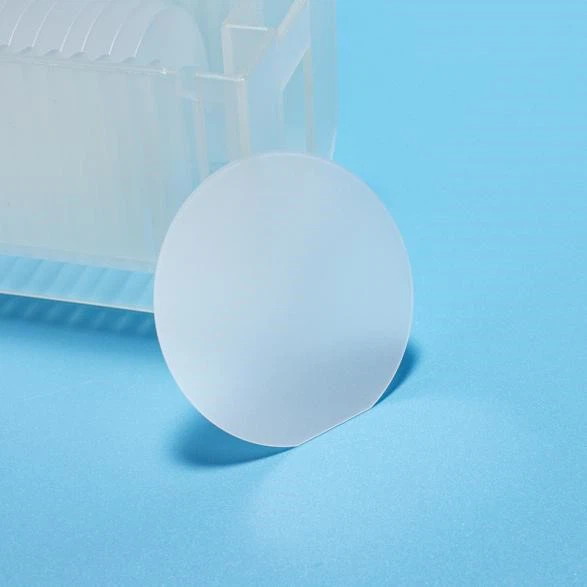

Manufacturers need to take into account the crystallographic orientation of the sapphire wafers when designing the processing steps. For example, when slicing sapphire ingots into wafers, the cutting direction should be carefully chosen to minimize the potential for stress - induced damage. Additionally, annealing processes can be used to relieve the internal stresses and improve the quality of the wafers.
Applications in Different Industries
Sapphire wafers find applications in a wide range of industries, and the CTE plays a crucial role in each of them:
1. Semiconductor Industry
As mentioned earlier, sapphire wafers are used as substrates for the growth of semiconductor materials in the production of LEDs, laser diodes, and other optoelectronic devices. The low CTE helps to improve the yield and performance of these devices by reducing thermal stress.
2. Aerospace and Defense
In aerospace and defense applications, sapphire wafers are used in optical windows, sensors, and other components. The ability of sapphire to maintain its dimensional stability over a wide range of temperatures makes it suitable for use in harsh environments, such as high - altitude and high - temperature conditions.
3. Medical Industry
Sapphire is also used in the medical industry, for example, in endoscopes and other medical imaging devices. The low CTE ensures that the optical components in these devices remain accurate and reliable, even when they are sterilized at high temperatures.
Our Sapphire Wafer Products
At our company, we offer high - quality Sapphire Wafer with precise control over the crystallographic orientation and CTE. Our sapphire wafers are available in various sizes and thicknesses to meet the specific requirements of different applications.
In addition to sapphire wafers, we also supply Sapphire Light Guide Rod and Sapphire Light Guide Block. These products also benefit from the low and anisotropic CTE of sapphire, which ensures their stability and performance in optical applications.
Conclusion
The coefficient of thermal expansion of sapphire wafers is a critical property that affects their performance in a wide range of applications. The low and anisotropic CTE of sapphire makes it an ideal material for use in optoelectronic devices, optical components, MEMS, and other high - tech industries. As a supplier of sapphire wafers, we understand the importance of this property and strive to provide our customers with products that meet the highest quality standards.
If you are interested in our sapphire wafer products or have any questions about the coefficient of thermal expansion and its impact on your applications, please feel free to contact us for a procurement discussion. We are always ready to provide you with the best solutions and support.
References
- "Properties of Sapphire" - Handbook of Optical Materials
- "Thermal Expansion of Single - Crystal Sapphire" - Journal of Applied Physics
- "Sapphire in Optoelectronic and Microelectronic Applications" - Proceedings of the IEEE


