

How is a Sapphire Wafer made?
Leave a message

Hey there! I'm a supplier of Sapphire Wafer, and today I'm gonna walk you through the process of how a Sapphire Wafer is made. It's quite an interesting journey, so let's dive right in!
Starting with the Basics: What is Sapphire?
First off, sapphire is a form of the mineral corundum, which is basically aluminum oxide (Al₂O₃). It's known for its hardness, second only to diamond on the Mohs scale. This makes it super useful in a bunch of high - tech applications. Sapphire has excellent thermal, electrical, and optical properties, which is why it's so popular in making things like Sapphire Wafer, Sapphire Light Guide Rod, and Sapphire Light Guide Block.
The Raw Material: High - Purity Aluminum Oxide
The first step in making a Sapphire Wafer is getting the right raw material. We use high - purity aluminum oxide powder. This powder needs to be extremely pure, usually with a purity level of 99.99% or even higher. Any impurities can mess up the quality of the final sapphire product.
Crystal Growth: The Key Process
There are a few different methods to grow sapphire crystals, but one of the most common ones is the Czochralski method. Here's how it works:
- Melting the Aluminum Oxide
- We put the high - purity aluminum oxide powder into a special crucible made of a material that can withstand really high temperatures, like iridium. Then, we heat the crucible using a powerful heating element. The temperature needs to reach around 2040°C (3692°F), which is super hot! As the powder melts, it turns into a molten pool of aluminum oxide.
- Seeding the Crystal
- Once the aluminum oxide is molten, we introduce a small seed crystal. This seed crystal is like a starting point for the new sapphire crystal to grow on. We slowly lower the seed crystal into the molten pool and start rotating it. The rotation helps to ensure a more uniform growth of the crystal.
- Crystal Growth
- As the seed crystal rotates, the molten aluminum oxide starts to solidify around it. We carefully control the temperature and the pulling speed of the seed crystal. By slowly pulling the seed crystal upwards at a precise rate, we can grow a large, single - crystal sapphire ingot. This process can take several days, and we have to monitor it closely to make sure the crystal grows properly.
Another method is the Heat Exchanger Method (HEM). In this method, a heat exchanger is used to control the temperature gradient around the growing crystal. It's a bit different from the Czochralski method, but the end goal is the same: to grow a high - quality sapphire crystal.
Shaping the Ingot
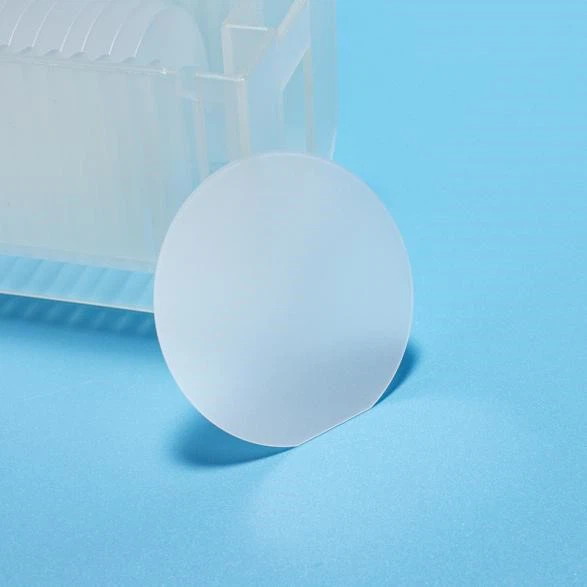
Once the sapphire crystal ingot is grown, it's time to shape it. The ingot is usually a long, cylindrical piece, but we need to turn it into a wafer.
- Cutting the Ingot
- We use a diamond - edged saw to cut the ingot into slices. This is a very delicate process because we need to make sure the slices are of the right thickness and have a smooth surface. The thickness of the slices depends on the requirements of the final Sapphire Wafer. For example, some wafers might be a few hundred micrometers thick, while others could be thinner or thicker.
- Lapping and Polishing
- After cutting, the slices are rough and have some irregularities. We use a lapping process to make the surfaces flatter and more uniform. Lapping involves using a lapping machine and a special abrasive slurry. The slurry contains tiny abrasive particles that gradually wear down the surface of the slice.
- Once the lapping is done, we move on to polishing. Polishing is a more refined process that gives the wafer a mirror - like finish. We use different types of polishing pads and polishing compounds to achieve the desired smoothness and surface quality.
Quality Control
Quality control is a crucial part of the process. We use a bunch of different techniques to check the quality of the Sapphire Wafer.
- Visual Inspection
- First, we do a visual inspection. We look for any visible defects like cracks, scratches, or inclusions. Even a small scratch can affect the performance of the wafer in some applications.
- Metrology
- We use metrology equipment to measure the thickness, flatness, and other physical properties of the wafer. This ensures that the wafer meets the required specifications. For example, the flatness of the wafer needs to be within a certain tolerance range.
- Optical and Electrical Testing
- Since sapphire wafers are often used in optical and electrical applications, we also perform optical and electrical tests. We check things like the optical transparency, refractive index, and electrical conductivity of the wafer.
Applications of Sapphire Wafers
Sapphire Wafers have a wide range of applications. In the semiconductor industry, they are used as substrates for growing other semiconductor materials. They are also used in the manufacturing of LED chips because of their excellent thermal and optical properties. In the optical industry, Sapphire Wafers are used in lenses, windows, and other optical components. And in the medical field, they can be used in some high - precision medical devices.
Why Choose Our Sapphire Wafers
As a supplier, we take pride in the quality of our Sapphire Wafers. We have strict quality control measures in place at every step of the manufacturing process. Our wafers are made from the highest - purity raw materials and are grown using state - of - the - art crystal growth techniques. Whether you need Sapphire Wafers for semiconductor applications, optical devices, or something else, we can provide you with a product that meets your requirements.
If you're interested in purchasing Sapphire Wafers, Sapphire Light Guide Rods, or Sapphire Light Guide Blocks, feel free to reach out to us. We're always happy to discuss your needs and provide you with a quote. We can also offer technical support and advice to help you make the best choice for your application.

References
- "Sapphire: Growth, Properties, and Applications" by some well - known materials science experts.
- Industry reports on sapphire manufacturing processes.
So, that's the story of how a Sapphire Wafer is made. It's a complex but fascinating process that results in a high - quality product with a wide range of uses. I hope this blog has given you a better understanding of the world of sapphire wafers!


